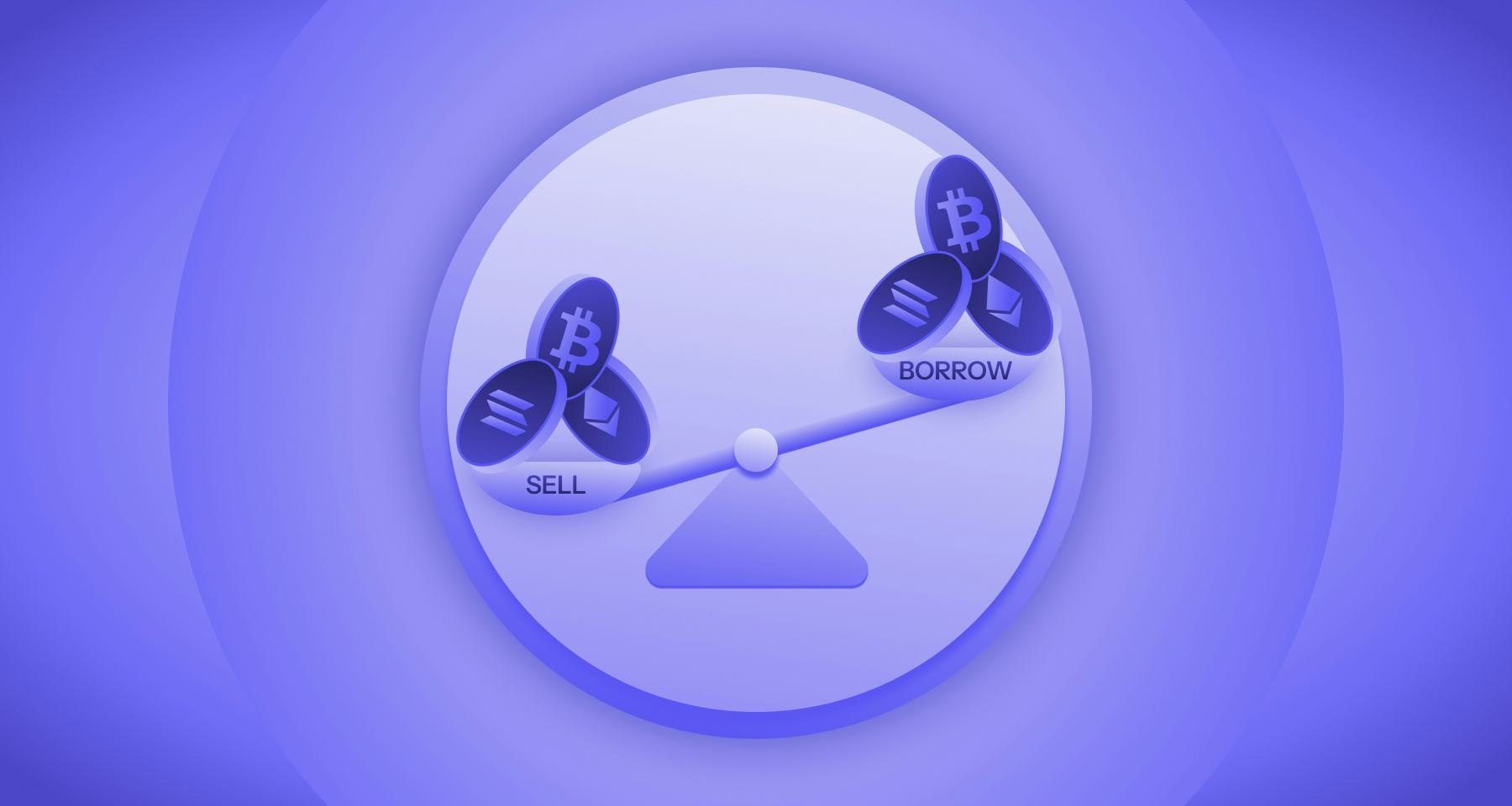
Whether to sell your crypto or borrow against it comes down to which cost you would rather carry: selling triggers a taxable gain and ends your position, while borrowing keeps your coins but adds interest cost and liquidation risk. Borrowing against crypto generally is not a taxable event, so a crypto-backed loan can raise cash while preserving your upside if you have conviction in the asset and a repayment plan; selling is the cleaner choice when you need certainty or the amount is small relative to the fees.
If you need cash but believe in the crypto you hold, borrowing against it keeps your position while selling ends it. That difference carries a price on both sides: selling realizes a gain and gives up any future upside, while borrowing adds interest cost and liquidation risk. Neither path is free. The right one depends on your time horizon, how much you need relative to the fees, and how much conviction you have in the asset.
This is general information, not tax or financial advice; consult a tax professional.
The two paths, side by side
You hold crypto and you need cash. You have two clean options.
Selling converts some of your crypto to dollars. The cash is yours with no strings, but your position is smaller than it was, and you have realized a gain or a loss on whatever you sold. Once you sell, you no longer own that exposure.
Borrowing keeps the crypto in your name as collateral. You receive loan proceeds against its value, you still hold the coins, and you get them back when you repay. In exchange, you owe interest for the life of the loan, and you take on liquidation risk if the collateral falls far enough in value.
The two paths answer the same need in opposite ways. One trades the asset for certainty. The other keeps the asset and takes on cost and risk to do it.
What each path actually costs you
Line the costs up in two buckets and the decision gets clearer.
Selling has a realized-gain cost: you owe tax on the profit you locked in, and you give up the upside on the coins you no longer own. That second piece, the opportunity cost, is easy to overlook and may be the larger of the two.
Borrowing has an interest-plus-risk cost: the interest and fees you pay to hold the loan, plus the possibility that a sharp drop in your collateral triggers a forced sale at a bad price. Borrowing is not free money. It moves your cost from a tax bill today to an interest bill over time, with liquidation risk attached.
The real cost of selling
The most visible cost of selling is the tax on your gain. The larger and less obvious cost is what you give up: if you sell coins to raise cash and the asset appreciates later, that upside is gone. You converted a position you believed in into spending money.
On the tax side, one point is worth stating plainly and then leaving alone. For U.S. tax purposes, the IRS treats digital assets as property, not currency, so selling or otherwise disposing of crypto held as a capital asset is a taxable event that produces a capital gain or loss. Assets held longer than a year are generally taxed at long-term capital gains rates of 0%, 15%, or 20% depending on your income, while assets held a year or less are taxed as ordinary income. Borrowing against your crypto works differently on this point, which is part of why people consider it.
Obtaining a crypto-backed loan generally does not trigger an upfront taxable event. Tax treatment may vary based on individual circumstances. You should consult your tax advisor regarding any potential tax implications, including those that may arise from a liquidation due to a margin call.
The real cost of borrowing
Borrowing replaces a one-time tax bill with an ongoing interest cost. To weigh it, you need real numbers.
Figure publishes a representative example for its crypto-backed loan. At 50% loan-to-value (LTV), the example rate is 8.91% (9.999% APR); up to 75% LTV, it is 11.50% (12.62% APR)**. Both include a 1% origination fee. The loans carry a $5,000 minimum and a 12-month interest-only term, which means you pay interest during the year and the principal comes due at the end**. These are representative figures for illustration, not a live quote.
The risk you're taking on: liquidation
Interest is the cost you can see on day one. Liquidation is the cost that shows up only if the market moves against you, and it is the real price of keeping your exposure.
Because your loan is secured by crypto, the lender watches your LTV as prices move. Crypto can be volatile and can drop sharply. If your collateral falls far enough, your effective LTV climbs toward a liquidation threshold, and past that point the lender can sell your collateral to cover the loan, which may be at a depressed price.
Here is how quickly the math shifts. Say you deposit $100,000 in BTC at 50% LTV and borrow $50,000. If BTC drops 30%, your collateral is now worth $70,000, and your effective LTV is 71% ($50,000 divided by $70,000). Another leg down that pushes you past a liquidation threshold of roughly 85% could force a sale at the bottom of the move. That is the cost that balances the "keep your upside" benefit: the upside is only worth something if you are not liquidated out of it first.
On DeFi protocols like Aave, this liquidation happens automatically through a smart contract. It executes immediately, it is irreversible, and may land at the bottom of a downturn. There is no warning call, no grace period, and no human judgment involved.
Liquidation Protection as a cost lever
Figure offers a feature that changes this part of the cost equation. For an upfront, non-refundable fee of 2% of the loan amount6: Navigates to numbered disclaimer, Figure agrees not to perform margin calls or liquidations based on price movement during the term of the loan. A drop that would otherwise force a sale is deferred to the end of the term, buying you time to let the position recover or to arrange repayment.
It is a cost input, not a cure-all. The protection covers price declines only. It does not cover missed payments, defaults, or violations of loan terms, and it does not erase the problem at term end if your collateral has not recovered. It is also available only in CA, NY, FL, PA, AL, AK, GA, HI, MA, and UT. If you factor it in, add the 2% to your cost of borrowing and weigh it against how damaging a forced sale would be for your situation6: Navigates to numbered disclaimer.
A worked comparison: $100,000 in BTC, $50,000 in cash needed
Put the two paths side by side with the same starting point. All figures below are approximate and for illustration only; the tax figures in particular depend on your rate and holding period and are not a computed result.
Say you hold $100,000 in BTC that includes about $60,000 in unrealized gains, and you need $50,000 in cash.
Selling roughly $50,000 worth of BTC to raise the cash could cost approximately $9,000 to $12,000 in capital gains, depending on your rate and how long you held. You raise the cash, but you have shrunk your position and given up any future upside on the coins you sold.
Borrowing $50,000 at 50% LTV at a APR near 9% costs approximately $4,500 in interest over 12 months, plus the 1% origination fee. You keep all $100,000 of BTC exposure.
On those illustrative numbers, borrowing saves roughly $4,500 to $7,500 versus selling, and you retain the upside on the full position. That is the case for borrowing when you have conviction in the asset.
Now weigh the other side, because the borrow path has its own downside scenario. If BTC drops 30% during your loan, that same $100,000 in collateral is worth $70,000 and your effective LTV climbs to 71%. A further drop can force a liquidation at a depressed price, which could cost you far more than the tax you avoided. The interest saving is real, and so is the liquidation risk. Both belong in the comparison.
When selling is the better choice
Borrowing is not the smarter move by default. In several honest cases, selling is the better path.
Short horizons or an imminent cash need. If you need the money and have no plan or timeline to repay, an interest-only loan just defers the sale to term end. Selling now is cleaner.
Small amounts where fees dominate. The 1% origination fee plus interest can outweigh a modest capital gains cost on a small position. Do the math, and selling may be cheaper.
No conviction in the asset. If you would rather not hold the collateral, borrowing means paying to keep exposure you do not want. Selling exits the position and ends the cost.
There is a corollary worth keeping it view. Because the loan is interest-only, it needs a real repayment plan. If your only exit is selling the collateral, you are back to the taxable sale you were trying to avoid. And if you are borrowing at a very low LTV with a large buffer, or you have reserve collateral available to deposit in a drawdown, Liquidation Protection6: Navigates to numbered disclaimer may be unnecessary overhead rather than a smart add-on.
How to decide
Neither path is free, so the decision comes down to which cost you would rather carry. Three questions get you most of the way there.
How long is your horizon? A repayment plan and time to ride out volatility favor borrowing. A near-term need with no plan favors selling.
How big is the amount relative to the fees? Larger positions with real gains make the interest cost of borrowing look small against the tax cost of selling. Small positions can flip that.
How much conviction do you have in the asset? Conviction is what makes keeping exposure worth paying for. Without it, there is little reason to carry interest and liquidation risk to hold something you would rather be out of.
If borrowing fits, you can review the mechanics and current terms of a crypto-backed loan before deciding. If it does not, selling is a perfectly rational answer. The point is to price both paths honestly and pick the cost that fits your situation.
Frequently asked questions
Should I sell my crypto or borrow against it?
It depends on your time horizon, the size of the loan relative to the fees, and your conviction in the asset. Borrowing keeps your position and upside but adds interest cost and liquidation risk, while selling gives you cash with certainty but realizes a gain and ends your exposure.
Is borrowing against crypto taxable?
Obtaining a crypto-backed loan generally does not trigger an upfront taxable event, whereas selling crypto held as a capital asset is a taxable disposition. Tax treatment can vary with your circumstances, including a liquidation caused by a margin call. This is general information, not tax advice; consult a tax professional.
Is selling crypto a taxable event?
Yes. The IRS treats digital assets as property, so selling or disposing of crypto held as a capital asset produces a capital gain or loss. This is general information, not tax advice; consult a tax professional.
How much does a crypto-backed loan cost compared to selling?
A crypto-backed loan carries interest for the term plus a 1% origination fee, while selling carries the tax on your realized gain plus the upside you give up on the coins you sold. For larger positions with significant gains, the interest cost of borrowing may be smaller than the tax cost of selling, but you take on liquidation risk in exchange. See current rates for a specific estimate.
What happens to my crypto loan if the price of my collateral drops?
Because the loan is secured by your crypto, a sharp price drop raises your loan-to-value ratio, and past a liquidation threshold the lender can sell your collateral to repay the loan. Figure offers optional Liquidation Protection6: Navigates to numbered disclaimer for an upfront 2% fee in select states, which defers price-based liquidations to the end of the term.
When is selling crypto better than borrowing against it?
Selling is usually better when you have a near-term cash need with no repayment plan, when the loan is small enough that fees outweigh the tax cost, or when you no longer have conviction in the asset. In those cases, paying interest to keep exposure you do not want or cannot hold rarely makes sense.
This content is provided for educational and informational purposes only and does not constitute investment advice or an offer to sell securities. The information in this article reflects publicly available data as of August 2026 and may not reflect current conditions. Investing in digital assets, tokenized securities, or blockchain-based products involves risk, including the potential loss of principal. Consult with a financial professional before making investment decisions.