This article is for informational purposes and may reference products offered by Figure.

The Dependable Generation

A chapter shaped by overlap

The Sandwich Generation isn’t a formal generation like Baby Boomers or Gen X — it’s a phase of life, generally from 40 to 60. It’s what happens when adulthood stretches in many directions all at once. Many people find themselves supporting adult children and caring for aging parents, while trying to secure their own future. That overlap has become more common as people live longer, start families later, and financial independence is delayed for younger generations.

“We absolutely do feel part of the Sandwich Generation. We had children comparatively late, which accelerated the competing needs of an aging parent who was not well-prepared for her retirement years.

The additional mental load, finite hours in the day, and logistics can be some of the most taxing aspects, in addition to the financial ramifications.”*

— Garen, 52, California

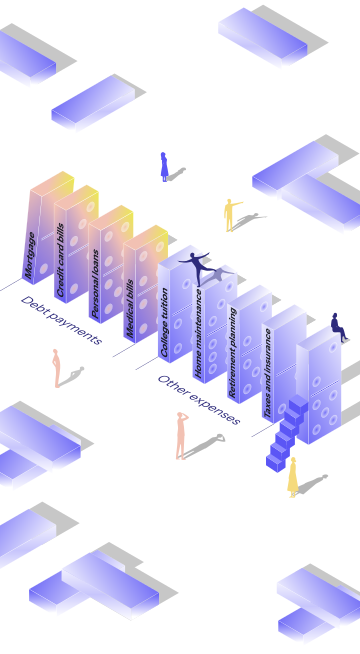
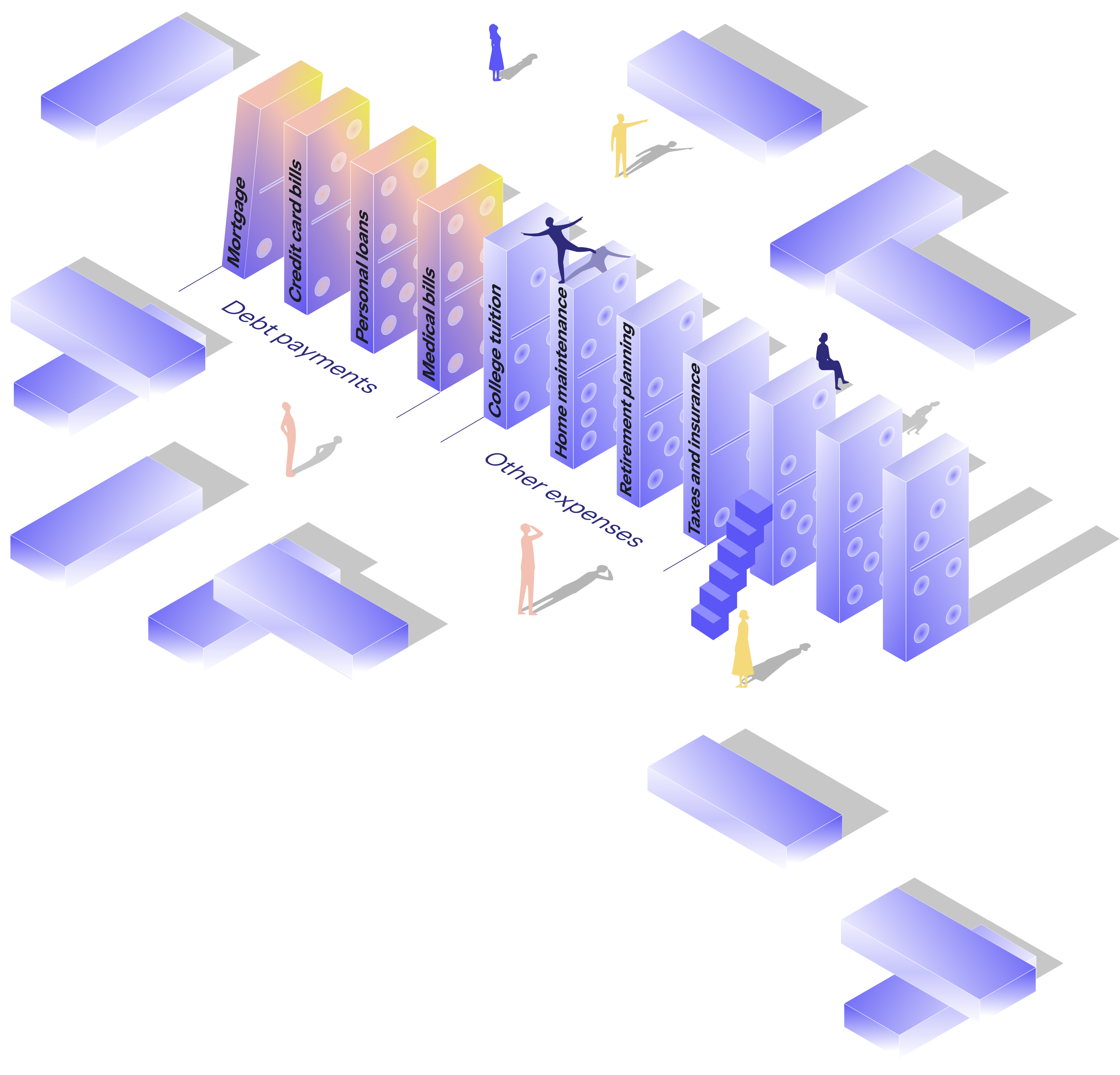
What makes this period so demanding isn’t simply the number of responsibilities landing all at once: caregiving, financial support, health needs, daily logistics, home maintenance, long-term planning, and more. It’s how interconnected they all are. It can feel less like a sequence of separate decisions and more like a row of dominoes standing close together, where one small shift quickly affects everything else.

*Results aren’t typical or guaranteed. Customer compensated for sharing their experience.

Because of this, the reality for many Sandwich Generation homeowners is that their home isn’t just a place to live — it’s a hub supporting multiple generations, each with different needs. And every financial decision carries extra weight, needing to stretch further and do more than one job.

To understand how this pressure shows up in real life, we turned to real data. Looking at more than 500,000 Figure and partner home equity line of credit applications between 2024 and 2025 helped us see how the Sandwich Generation is actively navigating this complex season of life.

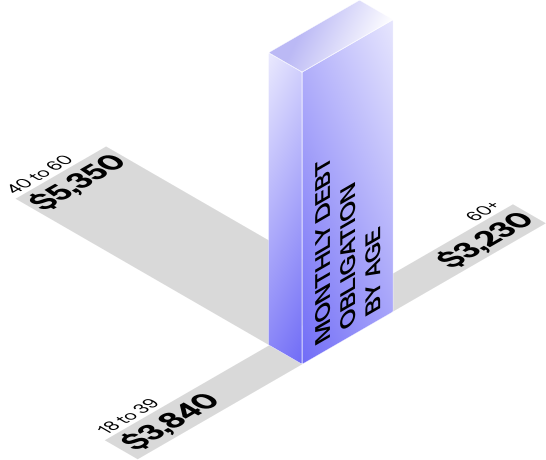
The data reflects what many in this stage already feel: The Sandwich Generation carries the highest monthly debt obligations of any age group, averaging $5,350 per month.
That's significantly more than younger adults or those over 60.
Monthly debt obligation by age. The 40 to 60 age group has the highest obligation of $5.35K. The 18 to 39 age group has $3.84K. The 60+ age group has $3.23K.
On average, Sandwich Generation homeowners are managing three different debt payments every month.
The scale of personal financial obligations including debt payments and other expenses. Debt payment categories include Mortgage, Credit card bills, Personal loans, and Medical bills. Other expenses include College tuition, Home maintenance, Retirement planning, and Fees and insurance.

Despite their high monthly debt obligations, these individuals have spent years building a strong financial foundation of solid credit, housing wealth, and years of responsible financial habits.

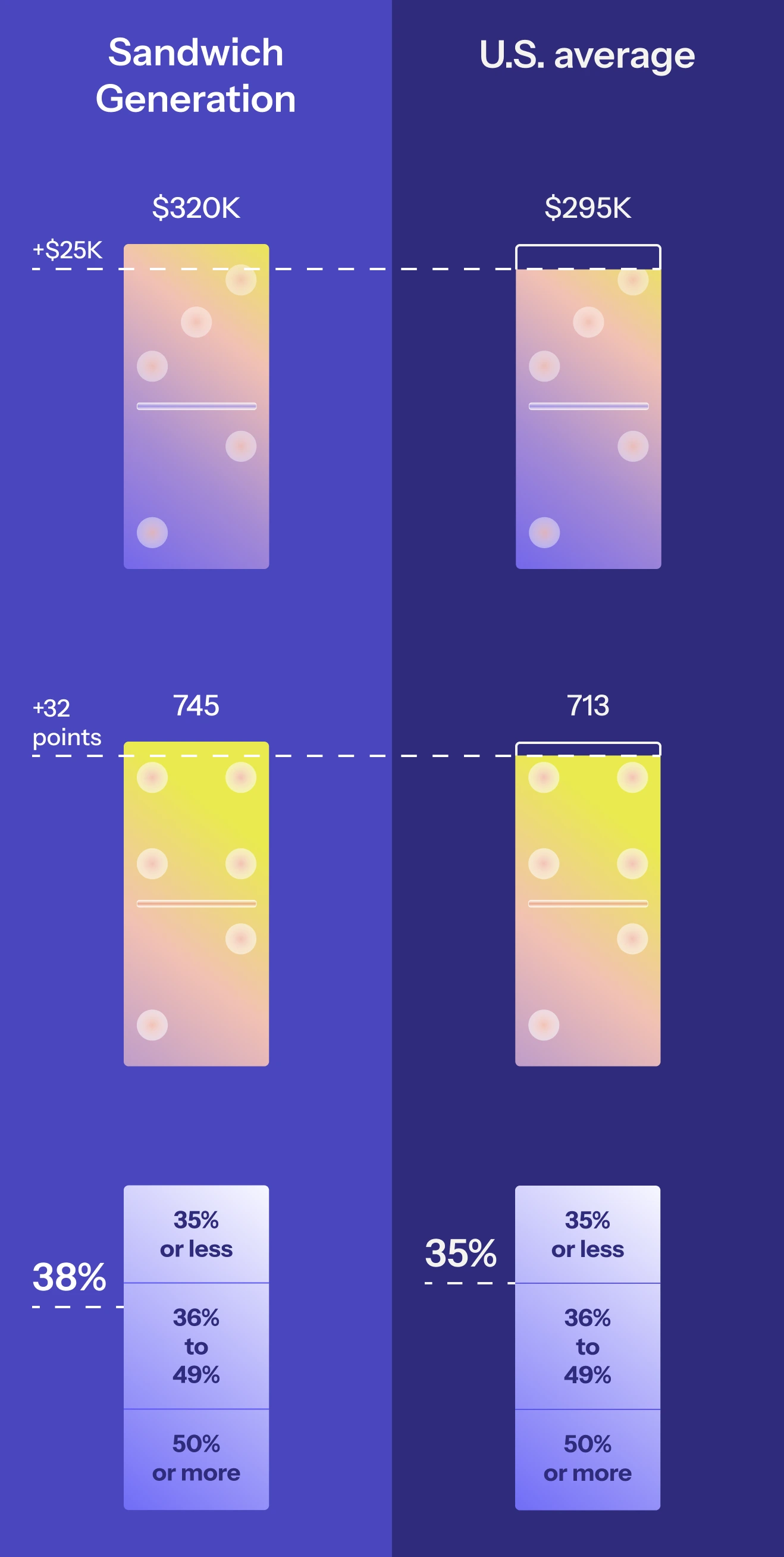
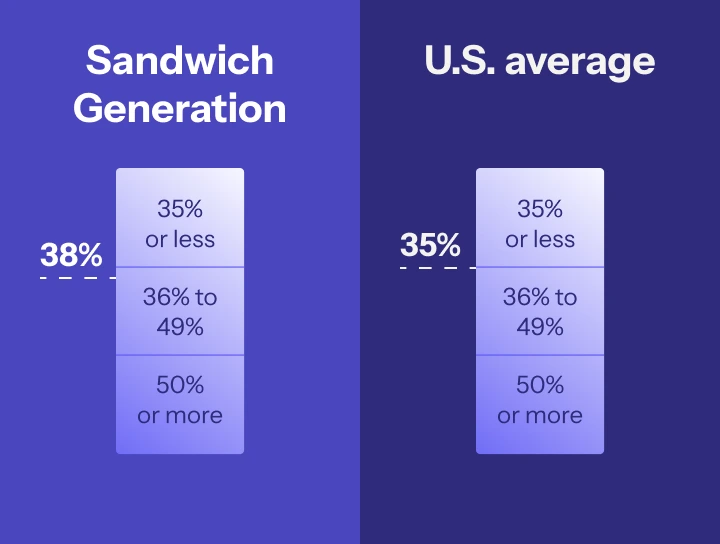
They have excellent credit scores (745 average, 32 points above the U.S. average), a debt-to-income ratio (DTI) within the healthy range (38%), and an estimated equity of $320,000 ($25,000 above the U.S. average).*

*This example is provided for illustrative purposes only.

Built to last

The financial strength of the Sandwich Generation home equity borrowers.

Home equity

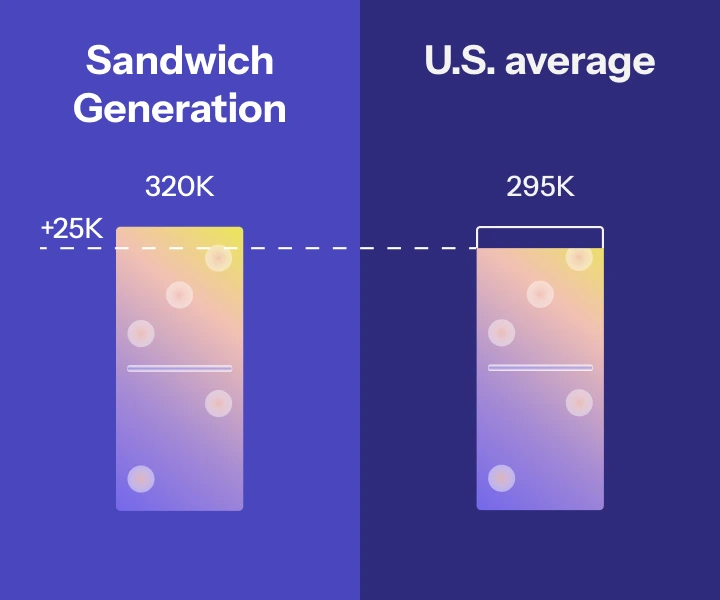
The portion of your home you truly own. If your home is worth $500K and you owe $180K, your equity is $320K.

Sources: Figure database (2024–2025) and Cotality research (2026)  Opens in a new window.

Home equity; The Sandwich Generation has an average of $320K in home equity, $25K higher than the U.S. average of $295K.

FICO score

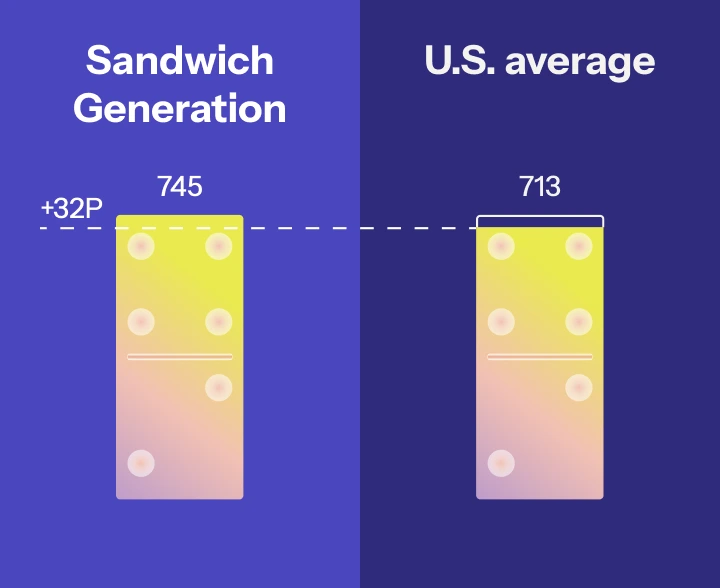
A number, from 300 to 850, that measures how reliably you’ve managed debt. Above 740 is considered very strong.

Sources: Figure database (2024–2025) and Experian research (2026)  Opens in a new window.

FICO score; The Sandwich Generation has an average FICO score of 745, 32 points higher than the U.S. average of 713.

Debt-to-income ratio

The percentage of your monthly income that goes toward debt payments. Below 35% is considered healthy.

Sources: Figure database (2024–2025) and Wells Fargo Money Study (2024)  Opens in a new window.

Debt-to-income ratio; The Sandwich Generation has an average debt-to-income ratio of 38%, 3% higher than the U.S. average of 35%.

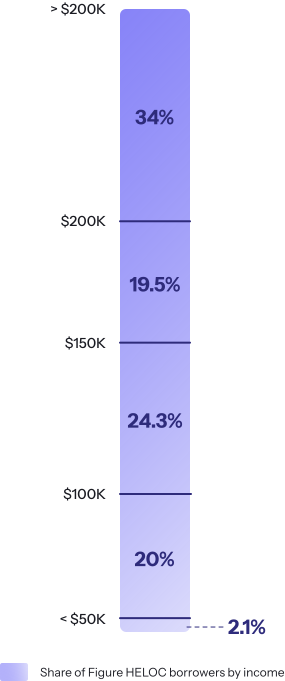
This group isn't lacking in earning power either. While the typical American household earns around $70,000 a year, most Sandwich Generation homeowners earn over $100,000, more than a third above $200,000. Their financial pressure comes not from how much is coming in, but how many directions it needs to go at once.

Even after doing so much right, many still feel a tension between what they’ve built and what’s needed now. With much of their wealth tied up in their home, the challenge is being able to use that equity when life calls for flexibility.

High incomes in a high-pressure world

The Sandwich Generation out-earns the average American ($70K).

Source: Figure database (2024-2025)

Share of Figure HELOC borrowers by income:

  • Less than $50K: 2.1%
  • $50K-$100K: 20%
  • $100K-$150K: 24.3%
  • $150K-$200K: 19.5%
  • $200K and above: 34%

When priorities pile up

When everything is important and nothing feels like it can be set aside, even a couple of overlapping needs can be overwhelming. College costs or supporting adult children coincide with an increase in a parent’s care needs. Medical bills hit the same year a house requires major maintenance. Retirement planning becomes more urgent, even as immediate family needs don’t let up. And a home that worked well a decade ago now has to function differently for aging, accessibility, or multigenerational living.

The challenges are cumulative. Important priorities are stacked close together, and the household budget absorbs the impact.

The pressure of family responsibilities

“I went through a divorce while my children were in middle and high school. After they graduated, college quickly came into view — and with it, significant expenses. Although they each received FAFSA loans, those funds were not enough for us to live on a single income while still meeting all of their needs. Higher education has always been important to me. I paid for my own education while working full time, and I wanted to provide my children with opportunities I did not have. Supporting them through college was a priority, even when it was financially challenging.”*

— Liz, 48, Georgia

Her debt grew out of responsibilities she considered essential — putting three kids through college — and managing a household alone. Warning signs started to flash during the first semester that all three kids were in college. She built a plan. She tracked spending carefully. She prioritized essentials and limited credit use. Still, progress felt slow and discouraging since she felt she was doing everything “right,” which took an emotional toll.

“I wasn’t making the progress I felt like I needed to be in complete control of my money. A HELOC was an option that I wanted to investigate when I got a letter in the mail about how it worked and that I wouldn’t have to refinance my home. Once I explored the options and rates, I knew that this could be the way to best help me get out of debt more efficiently and manage my money tighter.”*

The responsibility runs in both directions, supporting children while also caring for aging parents.

“When my mother got very ill with dementia, we had to put her in a home.My parents didn’t qualify for much financial support. So, my siblings and I had to pay for private care for three years, about $5,000 a month.I found myself taking out personal loans in order to cover those expenses and using my credit cards to pay for our water bill and groceries. It started to accumulate, eventually $87,000 in personal loans and $42,000 in credit cards.”*

— Norma, 62, California

Norma’s not alone. Most people in the Sandwich Generation lean on credit cards when things get tight or unexpected costs arise — in fact, 71% of them carry a balance. Altogether, they’re sitting on $248 million in card debt, which tops what they owe on their mortgages.

Unlike a mortgage that builds equity, credit card debt doesn't build anything. It just grows. High-interest debt balances can keep the dominoes in motion long after the moment of need, tightening monthly budgets and making it feel impossible to get back on track.**

Tipping the balance

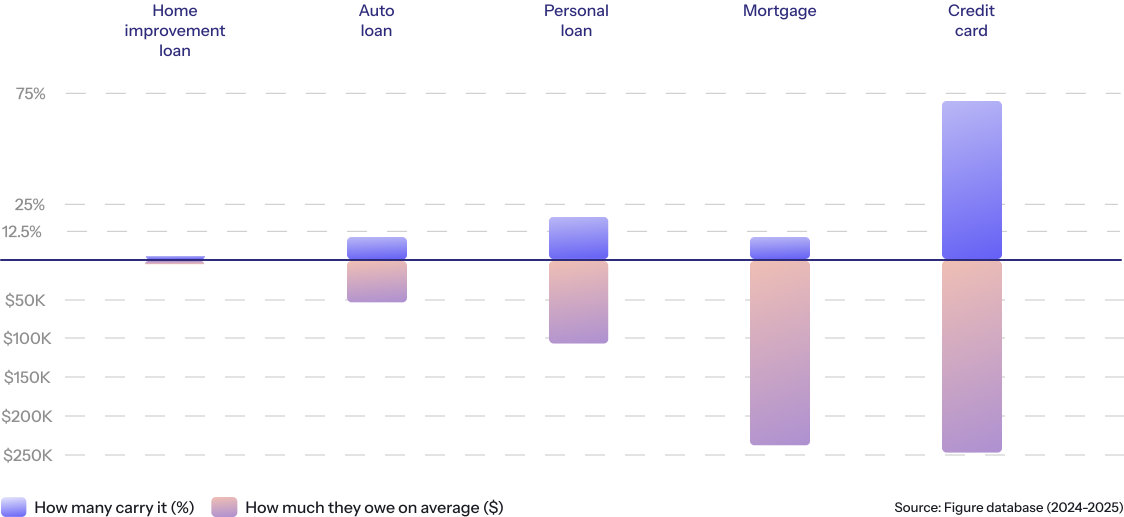
The Sandwich Generation has a long history of building wealth through their homes, but the pressure of current expenses has pushed credit card debt to the top of the pile, surpassing even their mortgage balances.

Source: Figure database (2024-2025)

A bar chart comparing the percent of the Sandwich Generation that carries certain types of debt compared to the amount they owe.

  • Home improvement loans: 1.4% carry owing $4M
  • Auto loan: 10.1% carry owing $53M
  • Personal loan: 18.9% carry owing $106M
  • Mortgage: 9.9% carry owing $238M
  • Credit card: 71.2% carry owing $248M

What changed for both Liz and Norma wasn’t discipline — they had already been doing everything they could. It was realizing they could use something they had been building all along.

By consolidating debt with their home equity, they rolled high-interest balances into a single, more manageable monthly payment. Instead of one expense tipping into the next, they were able to stop the chain reaction and regain control.

Liz and Norma’s experiences show a path forward that many Sandwich Generation homeowners don’t always see clearly: a large part of their wealth is already there, but historically hard to access.


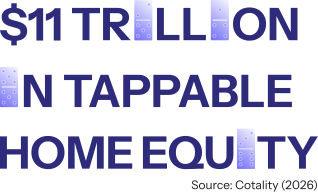
U.S. homeowners have more than
$11 trillion in tappable home equity   Opens in a new window.. Accessing even a portion of that wealth can create the breathing room to handle what’s in front of them and move forward with more confidence.

11 trillion dollars in tappable home equity

Using years of built-up equity for what matters most

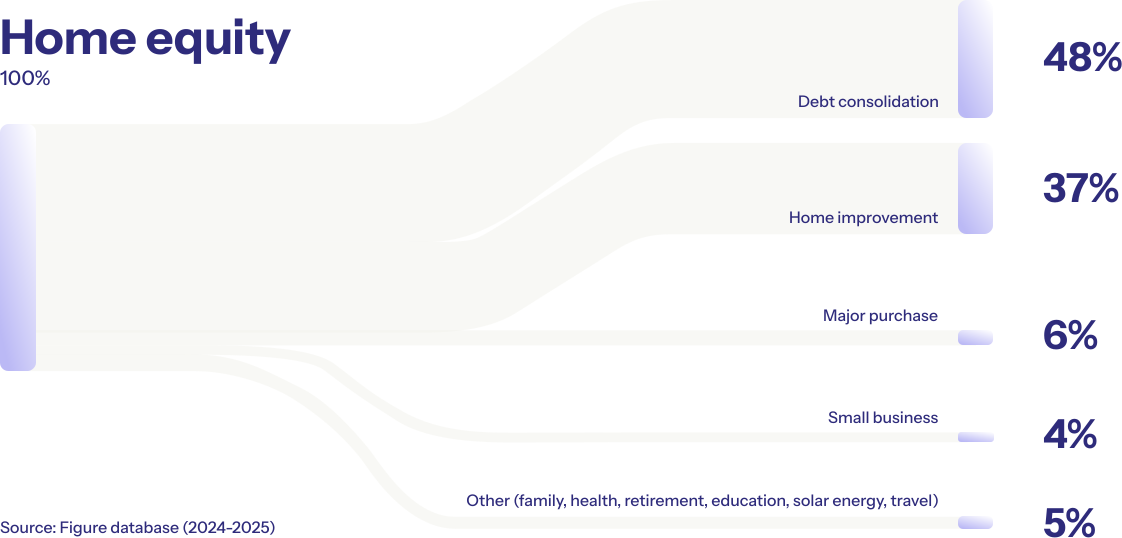
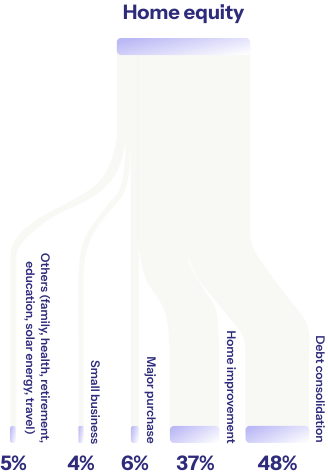
What the Sandwich Generation does with their home equity.

A chart showing what the Sandwich Generation does with their home equity.

  • 48% debt consolidation
  • 37% home improvements
  • 6% major purchases
  • 4% small business
  • 5% other (including family, health, retirement, education, solar energy and travel)

These categories look tidy on a chart, but real life isn’t so neatly divided. Needs often arrive all at once: high-interest debt demands consolidation just as urgently as a home needs repairs, and a loved one’s education requires investment just as much as a retirement account.

Home equity becomes a way to solve multiple challenges by making a single financial decision, like Patrick did:

“My mom had dementia and needed more care than Medicaid could provide,so I was helping her and my dad as much as I could. My mom's decline got worse. I was barely scraping by. I also needed a new roof and to take down trees on my property that were problematic during hurricane season.Using equity helped me pay off high-interest credit cards and fix my roof and trees. It gave me peace of mind.”*

— Patrick, 58, North Carolina

*Results aren't typical or guaranteed. Customer compensated for sharing their experience.
Adapting their home to fit real life

For the Sandwich Generation, home improvement isn’t just a financial decision, it’s a practical, personal, and emotional one. It’s about making home work better for the people living in it. As families grow, shrink, and new needs arise, homes need to adapt. Homeowners who are exploring using their equity tend to be financially strong.

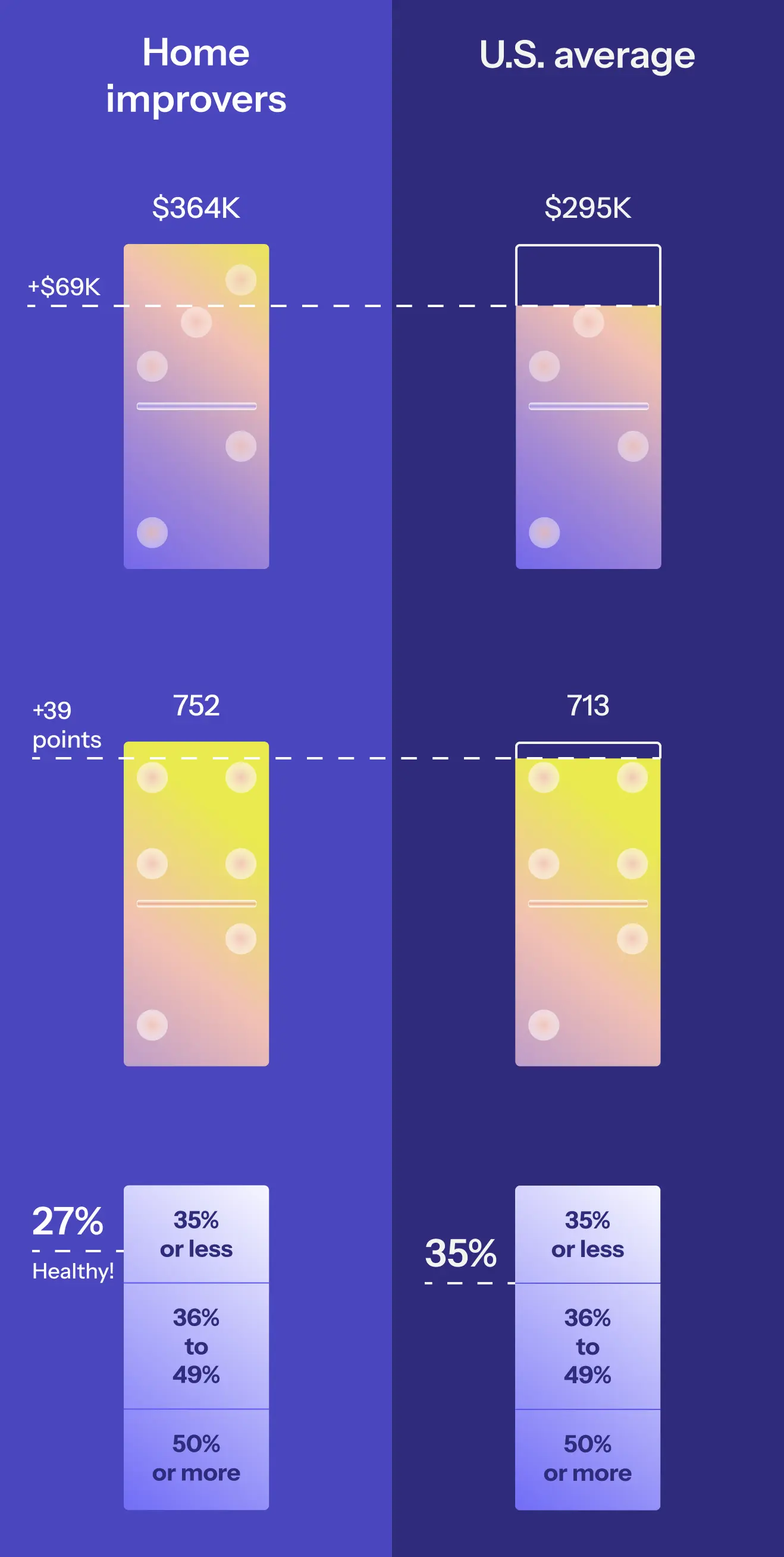
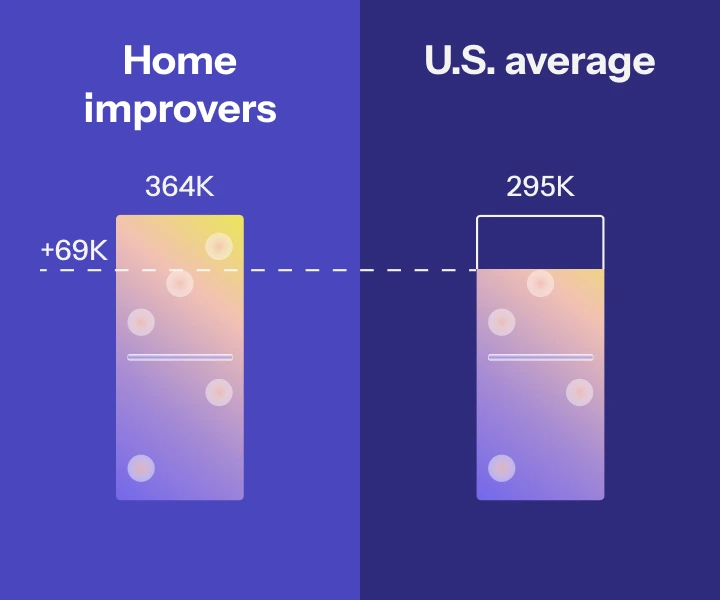
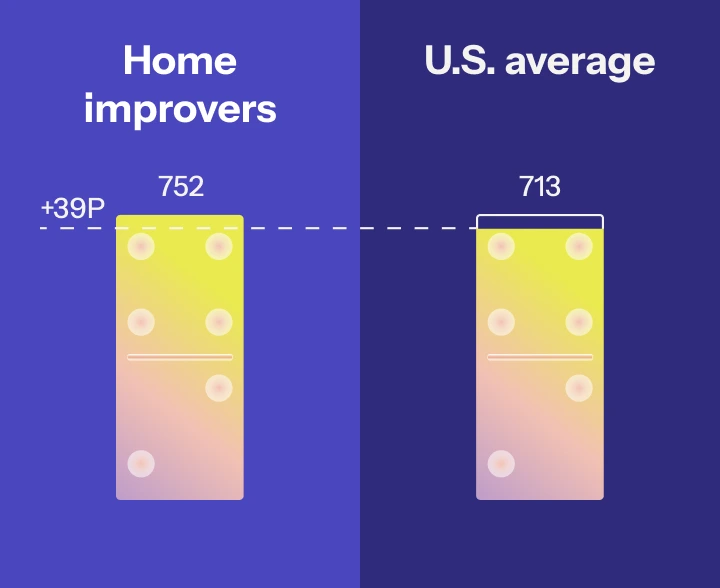
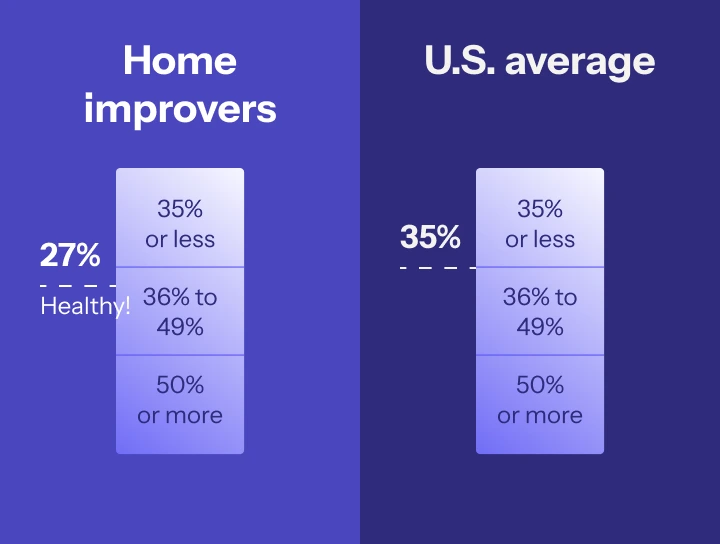
And those planning to reinvest it back into their homes are even stronger, with about $364,000 in equity (about $70,000 more than the U.S. benchmark), a 752 average FICO score (nearly 40 points north of the U.S. benchmark), and an excellent debt-to-income ratio (27%).

Home equity

The portion of your home you truly own. If your home is worth $500K and you owe $180K, your equity is $320K.

Sources: Figure database (2024-2025) and Cotality research (2026)  Opens in a new window.

Home equity; Home improvers have an average of $364K in home equity, $69K higher than the U.S. average of $295K.

FICO score

A number, from 300 to 850, that measures how reliably you've managed debt. Above 740 is considered very strong. Think of it as your financial reputation.

Sources: Figure database (2024-2025) and Experian research (2026)  Opens in a new window.

FICO score; Home improvers have an average FICO score of 752, 39 points higher than the U.S. average of 713.

Debt-to-income ratio

The percentage of your monthly income that goes toward debt payments. Below 35% is considered healthy. The lower the ratio, the more breathing room you have.

Sources: Figure database (2024-2025) and Wells Fargo Money Study (2024)  Opens in a new window.

Debt-to-income ratio; Home improvers have an average debt-to-income ratio of 27%, 8% lower than the U.S. average of 35%.

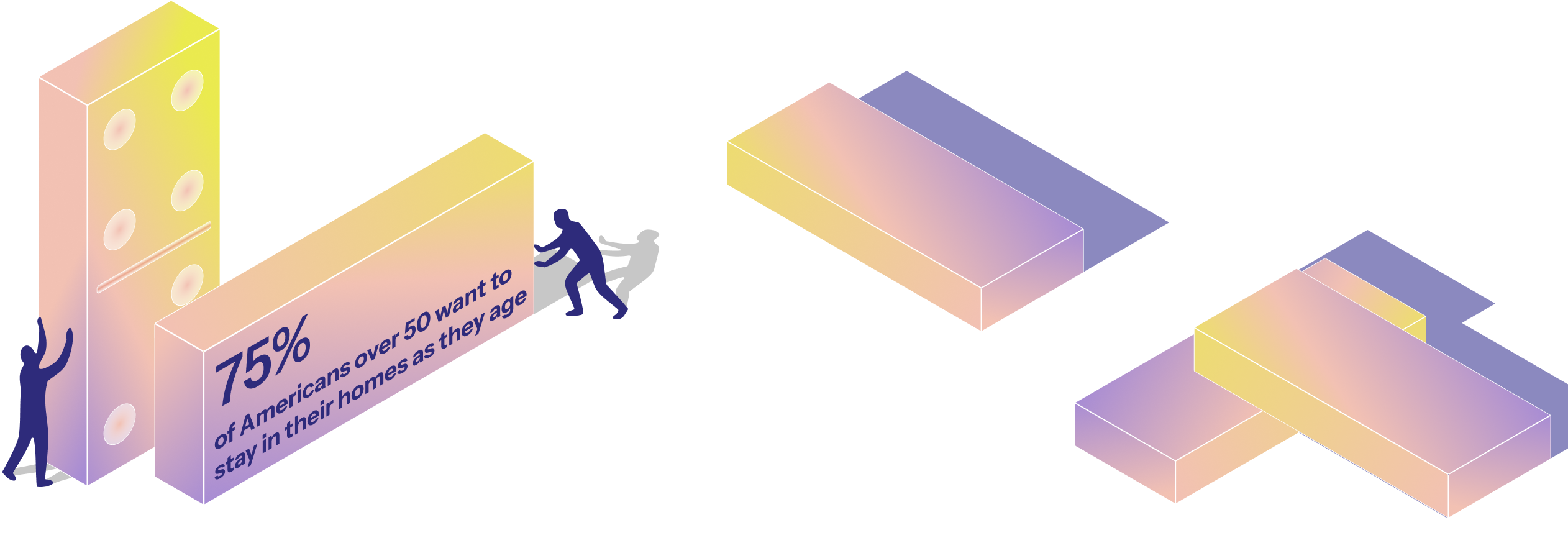
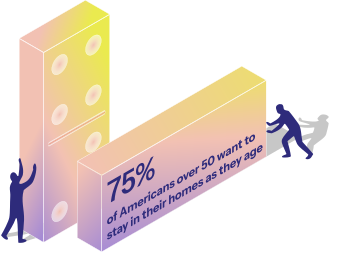
They’re thoughtful, measured decision-makers choosing to stay in their homes. According to AARP  Opens in a new window., 75% of Americans over 50 want to stay in their homes as they age, shaped by both emotional ties to their home and the reality of mortgage rates today.

75% of Americans over 50 want to stay in their homes as they age

Research shows that the bigger the gap between a homeowner’s current mortgage rate and today’s rates, the less likely they are to leave. Between mid-2022 and late 2023, that lock-in effect kept an estimated 1.33 million homes off the market.  Opens in a new window.


At the same time, demand is growing for homes that can support extended families, driven by rising housing costs, limited retirement savings, and a growing awareness of how hard it can be to age alone.  Opens in a new window.


So people stay. But most homes weren’t designed for aging bodies, multigenerational families, or the realities of daily caregiving. So staying comfortably often means making changes. They build additions, widen doorways, create separate living spaces, and fix problem areas to make their homes work for them.

Click on the card to read the story

*Results aren't typical or guaranteed. Customer compensated for sharing their experience.
Finding possibility and a new chapter amidst pressure

Home equity can do more than just solve urgent problems, like paying down debt or home improvements, in the short-term. It can also provide flexibility as the Sandwich Generation is trying to solve for the future and make the next chapter their best yet.

Becoming a small business owner

— Ericka, 52, New Hampshire

After debt piled up from caregiving, a divorce, and health challenges, Ericka used her home equity to consolidate high-interest debt, make necessary home repairs, and finally launch her own small business.*

Building a retirement income stream

— Jason, 43, Alabama

Jason used home equity to purchase adjacent back lots and create a private rental setup, turning his property into a source of supplemental income for retirement.*

Creating long-term family stability

— Garen, 52, California

To avoid the uncertainty of renting, Garen used his home equity to buy a condo for his mother-in-law, trading unpredictable rental costs for permanent stability.*