Consolidate debt with your home equity
A Figure HELOC can help you:
- Roll multiple high-interest balances into one potentially lower monthly payment
- Stop juggling due dates and compounding interest
- Access up to $750,0003: Navigates to numbered disclaimer of your home’s equity
- Get funded in as few as 5 business days2: Navigates to numbered disclaimer to pay off credit cards, auto loans, and more




What is a HELOC?
A home equity line of credit (HELOC) is a revolving line secured by your home's equity, which is the difference between what your home is worth and what you owe on your mortgage. You can borrow funds, pay down, and borrow again up to your limit, typically at lower interest rates since the loan is secured by your home.
Why homeowners consider a
HELOC for debt consolidation
Lower your interest rate
Figure customers who consolidate high-interest debts into a HELOC lower their rates by 9.5% on average.
Simplify your payments
Consolidate multiple bills into a single, manageable payment to simplify budgeting.
Pay off debt faster
Figure’s Intellidebt feature automates payoff by connecting directly to your accounts during application.
Flexible terms
Select from 10- to 30-year terms6: Navigates to numbered disclaimer with fixed1: Navigates to numbered disclaimer- or variable4: Navigates to numbered disclaimer-rate options to fit your financial goals with Figure.
Pros and cons of using a HELOC for debt consolidation
Below are the key advantages and considerations — and how Figure’s HELOC stands out.
Pros
- Lower interest rates
HELOCs typically offer lower rates than 20%+ credit cards, which can reduce your total interest costs. Figure provides competitive, fixed1: Navigates to numbered disclaimer- and variable4: Navigates to numbered disclaimer-rate options for qualified borrowers.
- Simplified finances
A HELOC lets you combine multiple balances into one monthly payment. Figure’s Intellidebt lets you pay off qualifying debts right in the application — no extra steps.
- Predictable payments
Figure offers a fixed-rate HELOC1: Navigates to numbered disclaimer option, so your monthly payment stays the same.
- Fast, fully online process
Some lenders require in-person steps, but Figure’s 100% online application can provide approval in minutes and funding in as few as 5 days2: Navigates to numbered disclaimer.
- Flexible terms
HELOC terms often range from 10 to 30 years. Figure offers multiple term options so you can choose what fits your monthly budget and long-term goals.
Cons
- Potential for longer total repayment
Extending your debt over 10 to 30 years may reduce your monthly payment but increase total interest unless you make extra payments.
- Your home is used as collateral
All HELOCs are secured by your home. This means you must stay current on payments to avoid putting your property at risk.
- Requires financial discipline
Consolidation only helps if you manage spending going forward. Even with Figure’s automated debt-payoff feature, avoiding new credit card balances is essential.
- Closing costs or fees may apply
Review fee structures carefully for additional costs like origination fees, notary fees, and more.
- Qualification requirements
Regardless of lender, HELOCs require sufficient equity, solid credit, and stable income. If you don’t meet these criteria, approval can be challenging.
Is a HELOC a good idea for debt consolidation?
A HELOC can be a helpful way to consolidate high-interest debt, and 45% of Figure customers use it for that purpose — but it isn’t the right tool for everyone. The key is understanding whether tapping your home equity through a HELOC aligns with your financial situation and long-term plans.
- You have substantial home equity available
Most lenders require you to maintain at least 15% to 20% equity in your home after borrowing. If your home has appreciated or you've paid down a good portion of your mortgage, you may qualify for a meaningful line of credit.
- You’re carrying high-interest debt
If you have credit cards with APRs above ~18% (current APRs average 21.4% Opens in a new window.), consolidating into a lower-rate HELOC may reduce your interest costs.
- You have consistent, reliable income
Since your home secures a HELOC, steady income to support monthly payments is essential to handle this additional financial commitment confidently.
- You’ve addressed the habits behind the debt
Figure's debt-consolidation process can simplify repayment, but it works best when you’ve put a plan in place to avoid rebuilding credit card balances afterward.
- Your equity is limited
If you recently bought your home or haven’t built much equity, you may not qualify for the amount needed to consolidate all of your outstanding debts.
- Your income is variable or uncertain
If your earnings fluctuate or job stability is uncertain, using your home as collateral carries heightened risk, as missing payments can risk foreclosure.
- You haven’t addressed spending patterns
If the behaviors that created the debt continue, you could end up with both a HELOC balance and new debts.
- You plan to move soon
You must repay the HELOC when you sell your home. If you’re likely to move in the next few years, a shorter-term unsecured option might be more practical.
How Figure’s HELOC can help you consolidate debt
Figure’s HELOC cuts out the delays of traditional lenders, with a streamlined online process built for speed and simplicity.


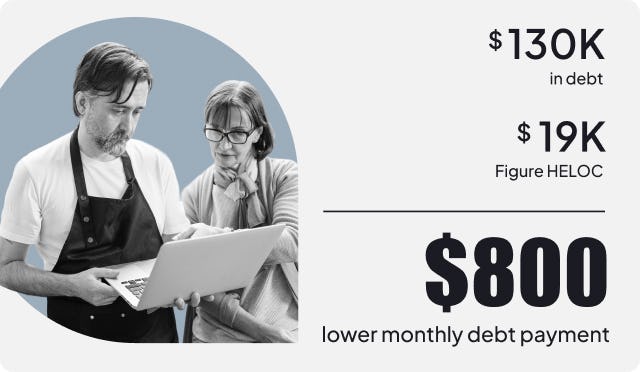
Figure HELOC vs. other debt consolidation options
| Figure HELOC7: Navigates to numbered disclaimer | Traditional bank HELOC* | Average personal loan** | |
|---|---|---|---|
| Application | 100% online, see your rate in minutes | Varies by lender, may require in-person processes | Varies by lender |
| Prepayment penalty | No | Varies by lender | Varies by lender |
| Tax deductible | For home improvement (consult a tax professional)5: Navigates to numbered disclaimer | For home improvement (consult a tax professional) | Not tax deductible |
| Funding speed | Funding in as few as 5 days on loans of $400k or less2: Navigates to numbered disclaimer | Could be weeks | Varies, generally quick |
| Average APR | Competitive6: Navigates to numbered disclaimer | Variable rates, potentially higher | Typically higher than HELOCs |
- * lendingtree.com/home/home-equity/the-fastest-way-to-tap-your-home-equity/
- ** money.usnews.com/loans/personal-loans/articles/personal-loan-vs-home-equity-loan-which-is-better
What to consider before using a HELOC to consolidate debt
Debt consolidation addresses the symptom — multiple high-interest debts — but not the cause. If overspending or insufficient budgeting or savings led to debt, consolidating alone won't solve the problem. Before proceeding:
- Identify the root causes of your debt.
- Create a realistic budget and build an emergency fund.
- Consider financial guidance if needed.
Without addressing these factors, you could end up with both HELOC debt and new credit card balances, creating a more serious financial challenge.
Unlike credit cards or personal loans, a HELOC uses your home as collateral. This means:
- Missed payments could eventually put your home at risk.
- You’re converting unsecured debt into secured debt.
- The loan remains even if your home’s value declines.
For those with steady income and discipline, this tradeoff may be worthwhile. If your income is variable, weigh whether the risk aligns with your risk tolerance.
Consider how long you’ll stay in your home:
- Selling soon? You’ll need to repay the HELOC, reducing sale proceeds.
- Planning renovations? Ensure enough equity remains.
- Relocating soon? Factor in timing and costs.
HELOCs typically make more sense if you plan to stay three to five years or longer.
Lower rates don’t always equal savings.
- Extending repayment could increase total interest paid.
- Compare your current payoff timeline to the HELOC term.
- Account for any fees
Use calculators to test scenarios and confirm the HELOC truly saves money — not just lowers your monthly payment.
A HELOC can help if you manage it wisely:
- Try setting a payoff goal and make extra payments when possible.
- Consider limiting or closing credit cards to avoid new debt.
- Track progress to stay accountable.
If you're confident in your repayment plan and want a straightforward way to use your home equity, a HELOC from a trusted provider like Figure can help you get started responsibly. Look for lenders that offer transparent terms, clear communication, and features designed to simplify the consolidation process — like automated direct debt payoff and fixed-rate1: Navigates to numbered disclaimer options for payment predictability.
Taking time to carefully consider these factors now can help ensure your debt consolidation strategy succeeds and improves your financial position for years to come.
How to qualify for a HELOC for debt consolidation
HELOC requirements vary by lender, but most follow similar requirements around credit, equity, and income.
Credit score
Most lenders look for good credit, typically in the 600 to 680+ range. Other factors and considerations:
- Higher scores may qualify for better rates
- Recent late payments can affect approval
- Improving your credit score before applying may lead to better offers
Home equity
Lenders require you to maintain 15% to 20% in remaining equity (your home’s value minus your mortgage balance) after the HELOC.
Income and debt
Lenders check that your income can comfortably support the new payment. Key factors:
- A debt-to-income (DTI) ratio under about 40% to 50%, including your HELOC
- Income must be steady and verifiable — Figure uses a secure digital tool, Plaid, to make this step easy
Property basics
- Primary residences tend to qualify most easily
- Second homes or investment properties may have stricter rules
Additional qualification factors
- Employment history and stability
- Property type and location
- Existing liens or judgments against the property
Figure’s streamlined process
Figure's 100% online application means you can get pre-qualified quickly. For loans under $400,0002: Navigates to numbered disclaimer, Figure's approval process may provide a decision in as few as 5 minutes, with funding in as few as 5 days2: Navigates to numbered disclaimer for qualified borrowers.
Ready to see if you qualify?
Take control of your debt and see if a Figure HELOC is right for you.
FAQs about using HELOCs for debt consolidation
For homeowners with equity, a Figure HELOC may be the fastest option. Traditional bank HELOCs take 2 to 6 weeks from application to funding, while personal loans take several days to a week. Figure’s process may offer approval in as little as 5 minutes and funding in as few as 5 business days2: Navigates to numbered disclaimer for qualified borrowers, helping you stop accumulating high-interest charges sooner.
Yes, paying off credit card balances with a HELOC is common since credit card APRs average 21.39% Opens in a new window., while HELOCs often offer much lower rates. For qualified borrowers, consolidating debt may help reduce interest costs over time. Figure’s Intellidebt feature streamlines this by connecting to your credit cards and paying them off during your application.
Initially, a HELOC may slightly lower your score due to a hard inquiry and new account. Over time, paying off high balances improves your credit utilization ratio and can raise your score. Making consistent, on-time payments further strengthens your credit profile.
Both can work for debt consolidation, but they differ in structure. A home equity loan offers a lump sum with fixed rates and payments — ideal if you know your payoff amount. A HELOC is a revolving line of credit. Figure’s HELOC combines both: fully disbursed at closing with fixed1: Navigates to numbered disclaimer- or variable-rate4: Navigates to numbered disclaimer options for added flexibility, and the option for additional draws over time as you pay down the balance.
Bank HELOCs take two to six weeks and require appraisals and paperwork. Figure’s streamlined process can approve in minutes and funding in as few as 5 business days2: Navigates to numbered disclaimer for qualified borrowers.
Interest may only be deductible if the funds are used to “buy, build, or substantially improve” your home, under IRS rules through 2025 Opens in a new window.. Laws may change in 2026, so consult a qualified tax professional for guidance.5: Navigates to numbered disclaimer
A HELOC can be used to consolidate most consumer debt, including credit card balances, personal loans, auto loans, and medical bills. Many consumers avoid using it for federal student loans, which have unique protections and forgiveness programs.
Savings depend on your rates and loan terms. For instance, consolidating $30,000 in credit card debt at 22% APR into a lower-rate HELOC could save thousands in interest for qualified borrowers, though results vary by individual circumstances, terms, and rates.
Related resources
- Debt ConsolidationHow to use home equity to pay off or consolidate debt
Shelby Hill article author
- Debt ConsolidationWhat is debt consolidation? How it works, pros, and cons
Shelby Hill article author
- Debt ConsolidationHow to consolidate debt: Best ways and when it's worth it
Alysse Guitar article author